By Paul Adams, Executive Director, BC Rural Health Network
“I just need to wait until there’s more money in my account.”
I’ve heard versions of that sentence in interviews with rural, remote and Indigenous patients across British Columbia. Sometimes the car insurance is due. Sometimes someone has just started a job and had to buy a vehicle to get there. The appointment is covered. Getting to it is another matter.
I’ve also interviewed people who told me they would rather die than sell their home or use up the savings their partner would need to live on. Many of those people have since died.
These are insured British Columbians who have lived, worked and raised families here. When someone tells me they’re too broke to get to a medical appointment, I believe them. In a BC study published in 2021, rural patients who travelled for care reported spending an average of $2,205 in out-of-pocket cost for one health condition. Some cancelled appointments because they couldn’t afford to go, since then costs have risen sharply.
Meet Joe and Jane. Joe needs a test in Vancouver. Jane can drive him, but it means time off work, gas, meals and possibly a hotel. BC’s Travel Assistance Program offers eligible patients discounts on some fares (primarily ferries). It leaves the fuel, meals and most accommodations to the patient and ignores the patients need for support from family or care providers. A referral won’t fill the tank.
Charities and non-profits step in and help fill the gaps but the gaps remain, perhaps you are lucky enough to have cancer and not a heart condition. Perhaps you are fortunate enough to be a child and not senior. Or perhaps you have learnt about the amazing folks at Hope Air and can get a flight (if you can get to the airport) but can no longer get any accommodations (due to increased demand and limited funding) on what can be multiple days of travel and sometimes months of care that has to occur outside of your community. Should we be discriminating on who gets help based on age, diagnosis or location? That doesn’t sound reasonable to me!
Now suppose Joe puts off the test until he’s sick enough to turn up in emergency. Here’s where common sense meets the provincial chequebook. A BC study used $504 for an emergency department visit, including the physician and hospital costs. It also cited $8,103 for a standard hospital stay in BC in 2021. If Joe needs an ambulance transfer 100 kilometres down the road, that takes a crew and a vehicle, too. Somehow, once Joe is sick enough, we can find the money to move him.
Saving money on Joe’s trip to get the test, only to spend thousands treating the crisis, is like burning hundred-dollar bills to start a fire. At least the fire would keep someone warm. The current approach leaves Joe and Jane out in the cold.
Help people afford the trip while there’s still time to do something about what the test finds. Common sense.
Congratulations. The paperwork is healthy.
In BC, you can be officially “attached” to a family physician who lives somewhere else, works in your community some weeks and has no appointment available for months. Congratulations on your attachment. How are you feeling?
Primary care is where a child gets vaccinated, a teenager gets help with anxiety, a pregnancy gets followed and someone notices that Mum’s falls started after her medication changed. It includes screening, diagnosis, treatment of illness and injury, chronic disease management, reproductive health, addictions care and palliative care. It also means somebody follows up after a hospital stay and connects you with rehabilitation, home care or other supports.
Nobody expects every village to offer every service. People do deserve to know whom to call, how soon they’ll be seen and how they’ll get there. BC’s own Primary Care Network framework calls for access within 24 hours for urgent, non-life-threatening needs and seven days for a non-urgent appointment. Ask rural patients how often that’s their experience. Then publish the answers.
A basic family physician office visit for someone aged 2 to 49 carries a fee of roughly $40. A standard 15-minute visit under the Longitudinal Family Physician model generates roughly $60 in direct physician payments, before other funding and really only works in high population densities.
An analysis of records obtained through freedom of information put the average Urgent and Primary Care Centre visit at $186 in 2024/25. That figure includes operating costs, so subtracting the physician’s fee from it won’t tell us what BC could save. The Ministry’s own records tell us something more useful about continuity. Of 898,000 visits, about 133,000 were by patients attached to the centre they visited, of those we have no data if they have any longitudinal relationships with a dedicated provider or just rotating random providers who don’t know them. Getting help today matters. So does knowing who’ll call about the test result on Thursday and if they understand the context of those results.
Give communities the funding and flexibility to build publicly funded teams around the people who can do the work locally. The nurse who knows Dad, the pharmacist who can review his medications, the community paramedic who visits him at home and the physician or nurse practitioner who can change his treatment all have something to contribute. So does Dad.
Common sense. Again.
A hospital gown is a poor substitute for a home
Sometimes Joe makes it through emergency, gets treated and is ready to leave. There’s just nowhere for him to go. His partner Jane, needs help to care for him safely at home. The long-term care home has a waiting list. So Joe stays in a hospital bed and someone who needs acute care gets treated in the hallway. Neither patient chose this arrangement. The nurse looking after both of them gets to explain it.
BC calls this alternate level of care. In 2024/25, the Seniors Advocate counted 20,449 seniors who spent time in hospital at this level, averaging 24 days. That’s more than three weeks in a one-size-fits-all gown with a rear ventilation system. Some of our elders die after spending years in these beds.
A study using 2019/20 data estimated that one additional alternate-level-of-care day in a BC hospital cost $620/day. In 2024/25, base funding for a contracted long-term care bed averaged $294 a day. Different years and different measures make the exact savings an open question. What we already know is that Joe wants to go home and the person in the hallway needs a bed. Why are we asking both to wait?
Invest more in public home support, public and non-profit long-term care, and palliative care close to home. Give the staff who do this work the time to do it well. This approach saves the taxpayer, provides compassion, and a fair bit of common sense.
I imagine an accountant somewhere can tell us what it costs to provide medical assistance in dying (MAID). I have a harder question. Did Jane who opted for MAID have the care and support she needed while she was living? If the spreadsheet can answer only the first question, I’d say the spreadsheet needs urgent treatment.
What should $36 billion buy us?
In April 2026, BC’s Health Minister told the Legislature that emergency departments had logged 8,645 hours of unplanned closures in 2024 and 7,262 in 2025. That’s 15,907 hours closed across the province in two years, almost entirely in rural and remote communities . An hour looks the same in a Ministry report whether the next emergency department is twenty minutes away or four hours down the highway. It feels quite different from the passenger seat.
At the BC Rural Health Network, we treat lived experience as evidence. Patients know what a missed trip cost them. Communities know which services have disappeared. Healthcare workers know what happens on the night shift after a home support visit was missed that day. We bring that knowledge together with research and ask the people who live with the consequences to help design the solution.
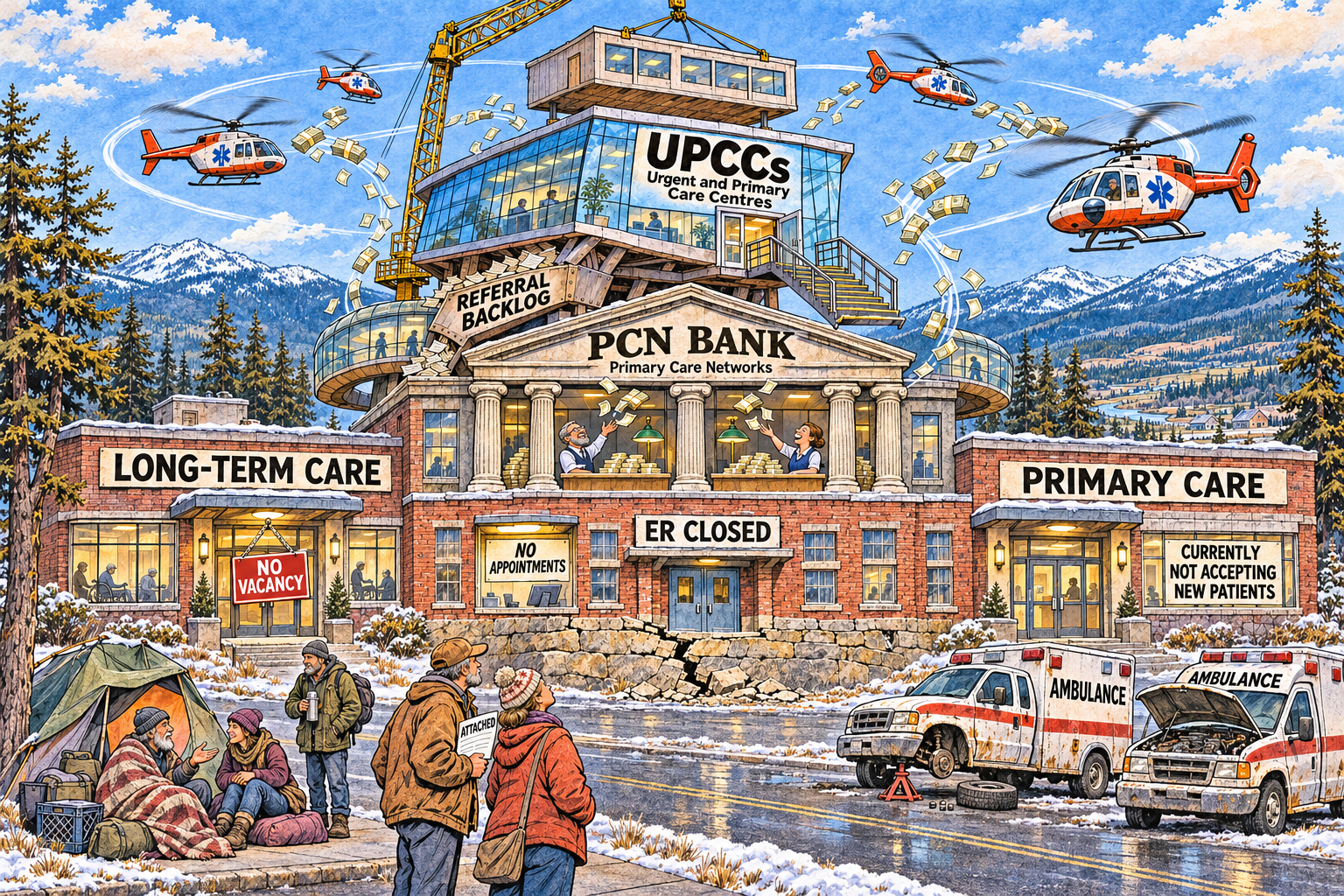
My math may be questioned. My humour certainly will be. As will my use of an generated AI image. So let’s gather the data and put the numbers where everyone can see them. What did the family pay? Did the patient get the test? Who followed up? How many ambulance transfers or hospital days did earlier care avoid? When a bed opened up, who got out of the hallway? Common sense should guide our thinking. Evidence must tell us whether we’re right.
BC’s Ministry of Health budget is $36.1 billion for 2026/27. Count health spending across the provincial government and September’s forecast comes to $40.6 billion out of $100.1 billion. That’s about 41 cents of every provincial dollar. For that kind of money, we ought to be famous for keeping people healthy. I’d settle, as a start, for getting Joe to his test.
A healthier province could spend less treating preventable crises and free up beds, ambulances and staff for the people who need them. Give the incoming government something worth measuring from day one. Fund the travel and accommodation when care has to happen elsewhere. Back local teams when it can happen close to home. Start at the edges, let communities show what works, and take what we learn to the rest of BC.
My grandchildren deserve to grow up in a province where a kid from a small town can train to be a nurse, a paramedic or a doctor, come home to practise and find a team worth staying for. Build enough communities like that and healthcare professionals will come here to work. Other countries will come here to learn.
We can create a Public healthcare system that patients can reach, professionals are proud to work in and the free world has good reason to envy. One that answers to the public and puts people’s health ahead of profit.
Invest in rural health for everyone’s wealth!
It is COMMON SENSE!