
Our mandate
The BC Health Coalition (BCHC) is a province-wide community of individuals and organizations dedicated to defending and improving public health care in British Columbia. We believe a strong, publicly funded health system should be accessible, equitable, and responsive to all British Columbians. Our partnership with the BC Rural Health Network is essential, as residents in smaller communities and rural areas often bear the brunt of underfunding, demographic changes, and structural challenges within the health care system.
The BCHC Board (Steering Committee) brings together an equal mix of labour and non-labour voices from across public health. We were pleased to have BCRHN staff member Dea Lewsaw of Salmo serve on our Steering Committee in 2024/25, followed by Lorraine Gerwing of Fort Nelson for 2025/26.
With the myriad of issues facing public health, our leadership has agreed that the Coalition’s first priority for 2026 is to mount a public-facing pro-public health care campaign. As we remind people what’s at stake if we allow public health care to erode into a two-tier, U.S.-style system, we can engage them to fight for the improvements we need, and safeguard the system we fought for in the days of Tommy Douglas.
This campaign will not be easy. Communities experiencing service gaps are not always eager to defend the system as it exists. But we must avoid “throwing the baby out with the bathwater.” Protecting our universal, publicly funded system is essential, even while pushing for improvements on multiple fronts.
A history of advocacy
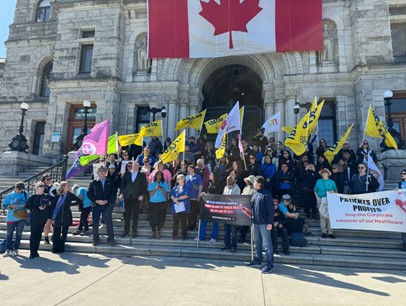
The Coalition has a long history of effective advocacy. In previous years, we intervened in the Cambie Surgeries case to prevent changes to the Canada Health Act, protected BC’s public voluntary blood donation system, successfully advocated for the elimination of unfair MSP fees, and supported the creation of the Office of the Seniors Advocate. We also helped secure government commitments to address surgical and diagnostic wait times, ran election campaigns to support public health care champions, and advocated nationally for improvements such as universal Pharmacare. The BCHC stands strongly against moving toward a two-tier, U.S.-style system. The research is clear: nations who have embraced this approach have longer wait times and reduced access for those in the public system. In Australia for example, a recent report found cancer patients in the lowest socioeconomic group had a 37% higher mortality rate than those in the highest socioeconomic group.
Looking back at 2025
It’s been a year of both challenges and victories. The BCHC called on the government for the public reintegration of diagnostic services. We worked with other provincial coalitions to highlight other threats from privatization, staffing shortages, and inequities in the system, and celebrated BC’s commitment to the national Pharmacare program. Across the province, we held workshops, webinars, and speaker panels to educate communities on health care issues and mobilize support for a stronger public system.
Solidarity with LifeLabs Technicians
In 2025, the provincial health care system continued to face serious pressures, including staffing shortages and the effects of privatization, exemplified by the strike of diagnostic technicians at the corporately owned LifeLabs. As we informed our membership about the unacceptable working conditions there, many were surprised to learn that LifeLabs is a private entity. Over time, governments have increasingly outsourced health care services that would ideally be operated within the public system.

For-profit entities like LifeLabs are accountable to shareholders and must generate a return on investment, even while receiving public funds per patient through MSP. This creates an inherent tension: to remain profitable, such companies may underpay workers, impose excessive workloads, or cut overhead—often at the expense of the quality of care delivered. When public dollars flow to private providers, there is a structural risk that patient care and safety can be compromised.
The role of the BCHC in situations involving unionized health care workers is to inform patients and stakeholders and to create opportunities for public solidarity. The working conditions of health care providers are directly tied to the quality of care patients receive. In cases like this, the public deserves to know that profit-driven corporations—such as Quest Diagnostics, the owner of LifeLabs—are directly responsible for decisions that erode both working conditions and patient care.
Primary Health Care
Strengthening primary health care delivery remains a key strategy to address system inefficiencies. The BCHC supports team-based, community-rooted models that include physicians, nurse practitioners, allied health professionals, and community health workers. In 2025, Coalition staff and Board members actively participated in the Ministry of Health’s engagement process related to the Cooperation and Responsible Government Accord (CARGA), which focuses on primary care reform, ensuring that community needs and patient-centered approaches are at the heart of system changes. The second CARGA report has just been released and we will continue to participate – looking for an opportunity to engage our members, should an opportunity for broader political engagement arise.
Members of the Coalition’s Steering Committee also engaged directly with the Ministry of Health, offering input on urgent system-wide challenges. Incoming Minister Josie Osborne and her staff consulted with BCHC-affiliated researchers, who outlined the structural drivers of the primary care crisis and its central role in cost overruns and gaps in care—especially for patients with complex and high needs. They stressed that improving outcomes requires a focus on meaningful access to primary care, not just formal attachment, so that people with greater needs can receive timely, high-quality care and avoid reliance on costly and often less effective emergency and hospital services.
Provincial and National Health Coalitions
BCHC collaborates closely with other provincial coalitions and our national counterpart. In 2025, we participated in SOS Medicare 3.0 in Ottawa and the People’s Shadow Summit in Huntsville following the federal election. These gatherings brought together advocates, researchers, and frontline workers to strategize for a stronger, more equitable health care system.

Advocating for better care in rural communities
We are well aware that rural communities face unique challenges. Access to timely and comprehensive care is often limited, and geographic distance can affect outcomes. BCHC advocates for strong hospitals and clinics, adequate staffing, telehealth solutions, and fair provincial funding. In partnership with the BC Rural Health Network, we amplify the voices of communities far from urban centres, including highlighting the need for accommodations for patients needing specialized care in Vancouver.
The road ahead
Looking to 2026, BCHC is preparing a major public campaign to defend public health care against privatization. Political leaders across Canada are increasingly opening the door to for-profit models, and we will work with provincial partners to uphold Tommy Douglas’s legacy, reminding British Columbians that access to care should be based on need—not wealth.
Our priorities for 2026 remain consistent with 2025: protecting Medicare, improving seniors’ care, advocating for patient-centered delivery, and strengthening rural and community-based primary care. By combining advocacy and public education, we mobilize communities to support policies that put patients first, protect public services, and maintain a health care system accessible to everyone, everywhere.
We look forward to continuing our work with the BC Rural Health Network and other partners to advance these priorities and ensure high-quality, publicly funded health care remains at the core of BC’s health system.