
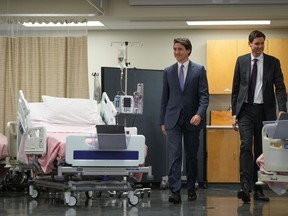
Prime Minister Justin Trudeau (left) and B.C. Premier David Eby arrive for a healthcare funding announcement at Kwantlen Polytechnic University, in Langley, B.C., on Wednesday, March 1, 2023. PHOTO BY DARRYL DYCK /THE CANADIAN PRESS
The $1.2 billion will go toward recruiting more nurses, reducing waiting times for diagnostic imaging and medical treatments, mental health and addiction support.
The union representing tens of thousands of B.C. nurses said $1.2 billion in federal health funding over three years will be key to fulfilling’s the new nurse-to-patient ratios announced by the province’s health minister earlier this year.
Health Minister Adrian Dix and his federal counterpart, Mark Holland, were at Vancouver General Hospital on Tuesday to announce that B.C. is the first province to reach an agreement with Ottawa over new health care and mental health funding.
Dix said part of that money will be used to overhaul the approach at 83 acute care sites so nurses can spend more time with patients.
Dix announced in April that B.C. would become the first province in Canada to set rules limiting how many patients each nurse can take care of, in an effort to keep burned-out nurses from leaving the profession. However, critics questioned whether the $750 million in provincial money over three years would be enough to hire the thousands of nurses needed to prop up a severely understaffed workforce.
B.C. Signs $1.2-Billion Health Deal With Ottawa
British Columbia is the first province to sign a health funding agreement offered by the federal government earlier this year. Under the deal, B.C. gets 1.2 billion over three years. Health Minister Mark Holland says the agreement also comes with federal support for B.C.s health-care system for the next 10 years. Oct. 10, 2023
The federal top-up “will go a long way to making (nurse-to-patient) ratios in British Columbia a reality,” said Adriane Gear, head of the B.C. Nurses’ Union.
Limiting the number of patients that nurses are caring for at any given time will be key to retaining nurses on the verge of burn-out and attracting nurses from other parts of Canada or internationally, Gear said.
California and Australia had major successes in attracting nurses after they set nurse-to-patient ratios, she said.
Gear estimated the province needs at least 5,000 more nurses to meet the proposed ratios, which are 1-to-1 for critical-care patients on ventilators, 1-to-2 for critical-care patients not on ventilators or those needing high-dependency mental-health care, 1-to-3 for specialized care, 1-to-4 for in-patient and palliative care and 1-to-5 for rehabilitative care.
The province has yet to set a date for when the nurse-to-patient ratios will come into effect, but they were a key part of the B.C. Nurses’ Union’s collective agreement ratified in May. Dix did not give a breakdown for how much of the $1.2 billion will be spent on hiring new nurses, doctors and health workers.
The federal cash will also go toward reducing waiting times for diagnostic imaging and medical treatments and increase access to mental-health and addiction supports. For example, B.C. will expand the number of Foundry centres — which the government has billed as “one-stop shops” for youth struggling with mental-health and substance use — from 16 to 35 across the province.
Addictions Minister Jennifer Whiteside did not give specifics when asked how much of the mental health funding will be used to increase the number of treatment facilities or overdose prevention sites in B.C. Last week, the province introduced a law that will ban open drug use in almost all public spaces but critics said the government’s announcement should have been coupled with funding for more supervised places to use drugs and more addiction and recovery beds.
The province will work with the First Nations Health Authority to improve access to culturally appropriate and trauma-informed treatment and care. Dix said this will address some of the concerns raised in the In Plain Sight report, which found Indigenous people face worse health outcomes because of systemic racism in the health system.
The funding includes $325 million a year in new funding and $82 million a year in previously announced mental health and substance use funding.
Holland also wants B.C. to increase the number of people who have access to their own electronic health information, the absence of which can be frustrating for people who see several different health practitioners because they don’t have a family doctor or team-based care.
The province will have to meet certain targets and publicly report on its progress each year.
The announcement comes a day before Holland, Dix and the country’s health ministers head to Charlottetown for a two-day meeting that is expected to focus on the shortage of health care workers across the country.
Holland said a top item for discussion will be whether Canada should implement a pan-Canadian licensing system, to allows nurses or doctors licensed in one province or territory to have their credential recognized across the country. Holland noted the Atlantic provinces already have such an agreement.
The Canadian Medical Association backs pan-Canadian licensing, saying it would reduce barriers to physician mobility and improve access to patient care.
After months of tense negotiations with the provinces and territories, the federal government in February announced it would increase federal health care transfers to the provinces and territories by $196 billion over 10 years, with B.C. getting a $27.47 billion share of that.