
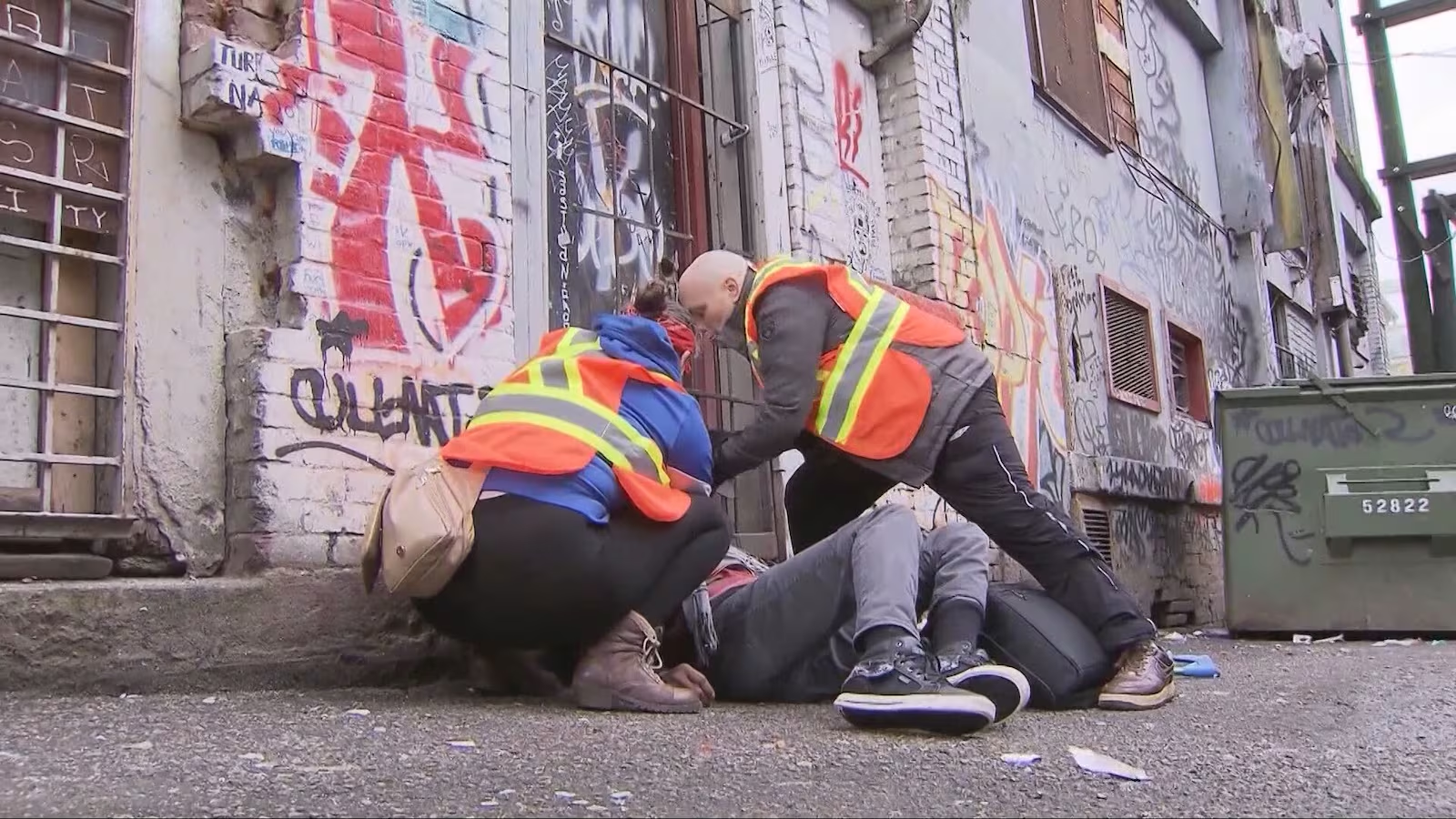
Members of the Downtown Eastside community are calling on the province to end its involuntary care plans, requesting easier access to detox beds instead.
By The Canadian Press March 13, 2025
British Columbia clinicians have received new guidance about involuntary care for adults, including a directive that it cannot be used to prevent harmful “risk-taking” by people who use drugs whose behaviour is not related to mental impairment.
The guidance from Dr. Daniel Vigo, B.C.‘s first chief scientific adviser for psychiatry, is aimed at helping clinicians and others decide when involuntary admission is appropriate for people with both mental-health and substance-use disorders.
Vigo said in a news release that involuntary treatment “can be a tool to preserve life and Health Minister Josie Osborne said the ongoing toxic drug crisis has led to a “small but growing number of people who are living with overlapping mental-health and substance-use challenges, as well as brain injuries from repeated overdoes.”
While the new guidance aims to ensure those people have the right support in place, it does not constitute changes to B.C.‘s Mental Health Act, she said.
“This is about providing a higher level of care to a very specific and vulnerable population,” she told a news conference announcing the guidance on Wednesday.
The 11-page guidance document outlines three main scenarios when someone with substance-use disorder may receive involuntary treatment — simultaneous mental disorders, acute and severe psychiatric syndrome with unknown causes, and ongoing mental impairment after remission from an acute state.
But it notes the legislation must not be used as a “controlling intervention to curb risky decision-making” that is unrelated to a state of mental impairment.
Vigo said the vast majority of people with mental disorders, including substance-use disorders, will not meet the “stringent threshold” for involuntary treatment.
“However, there is a fraction of a percentage point that in any given year will require it as a life-saving tool,” he told Wednesday’s news conference.
Vigo said substance-use disorders are a subtype of mental disorder, and many clinicians were already applying the legislation the way it was intended.
But he said the “siloed evolution” of addiction medicine and psychiatry had resulted in some making “misguided interpretations” along with “segregated services” that left patients suffering from concurrent disorders falling through the cracks.
“The problem is that we had not taken stock of the complexity of concurrent disorders and acquired brain injury in the context of addiction to those new drugs,” Vigo said of today’s highly toxic illicit drug supply.
“And for a time, there was a legitimate debate about whether the Mental Health Act applied or not. Now, in time, we have grown to understand that it does.”
Vigo said dispelling misconceptions about involuntary care in the Mental Health Act was a step toward supporting those patients, in addition to bringing new services online, including mental-health units in corrections facilities and care homes.
He said misinterpretation had resulted in the overuse of emergency involuntary care, but insufficient use of involuntary care over a minimal duration in order to adopt a strategy that “has a shot” at treating the root cause of the condition.